Anisotropic Flow of Identified Hadrons by the Event Plane Method at FAIR Energies
DOI:
https://doi.org/10.14331/ijfps.2015.330081Keywords:
Anisotropic flow, Elliptic flow, Scaling, Quark Coalescence, Transverse kinetic energyAbstract
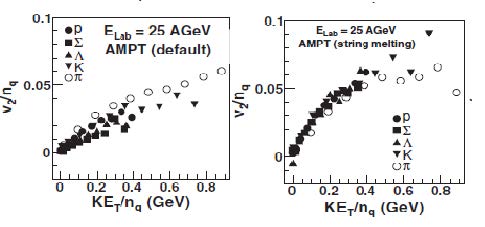
A comprehensive study of the elliptic flow of hadrons for non central Au+Au collision with the impact parameter of b =5-9 fm in the mid rapidity region of (-1 ≤ ycm ≤1) with the reaction plane angle Ψ in the mid-pseudorapidity of |ɳ| < 0.35 is investigated in the FAIR energy regime of 25 A Gev by the AMPT model with both the default and the string melting scenarios. In both the versions of AMPT model, we have observed that at low PT regions upto PT ≈ 1.0 GeV/c, elliptic flow shows an almost linear increase with the increase in the transverse momentum . Also there is a clear mass ordering effect that is particles with higher mass shows a smaller at a given PT than the particles with lower mass. In addition the constituent quark number scaling of elliptic flow has been investigated where we have observed a universal scaling in the string melting version of the AMPT model i.e with the partonic degrees of freedom due to quark coalescence model compared with the default version of the AMPT model. Further the scaling behavior has been observed for the transverse kinetic energy with both scenarios.
Downloads
References
Voloshin, S. A., Poskanzer, A. M., & Snellings, R. Collective phenomena in non central nuclear collisions. arXiv:0809.2949 [nucl-ex].
Ollitrault, J. Y. (1992). Anisotropic as a signature of transverse collective flow. Physical Review D 46, 229.
Poskanzer, A. M., & Voloshin, S. A. (1998). Methods for analyzing anisotropic flow in relativistic nuclear collisions. Physical Review C 58, 1671.
Adams, J., et al. (2005). Experimental and theoretical challenges in the search for the Qurak Gluon Plasma: The STAR Collaboration’s Critical Assessment of the evidence from RHIC Collissions. Nuclear Physics A757, 102.
Back, B. B., et al. (2005). The PHOBOS perspective on Discoveries of RHIC. Nuclear Physics A 757, 28.
Ollitrault, J. Y. (1998). Flow systematics from SIS to SPS. Nuclear Physics A 638, 195c
Sorge, H. (1997). Elliptic flow: A signatures for early pressure in ultra-relativistic nucleus-nucleus collisions. Physics Review Letters 78, 2309
Alt, C., et al., (2008). Pion and kaon production in central Pb + Pb collisions at 20 A and 30 A GeV evidence for the onset of deconfinement NA49 collaboration. Physics Review C 77, 024903
Alt, C., et al., (2003). Directed and elliptic flow of charged pions and protons in Pb + Pb collisions at 40 A GeV and 158 A GeV NA49 Collaboration. Physics Review C 68, 034903
Stoecker, H. (2007). arXiv:0710.5089v1 [hep-ph]; Stoecker, H. (2005). Nuclear Physics A 750, 121-147
Lacey, R. A., Taranenko, A., et al. (2006) What do elliptic flow measurements tell us about the matter created in the little Bang at RHIC, 021.
Lin, Z. W., & Ko, C. M. (2002). Partonic effects on the elliptic flow at RHIC. Physics Review C 65, 034904; Lin, Z. W., Ko, C. M., Li, B. A., Zhang, B., & Pal, S. (2005). Multiphase Transport Model for relativistic Heavy Ion Collisions 72, 064901
Poskanzer, A. M., & Voloshin, S. A. (1998). Physics Letters C 58 1673
Wang, X. N., & Gyulassy, M. (1991). Hijing: A Monte Carlo Model for multiple jet production in PP, PA and AA collisions. Physics Review D 44, 3501
Lin, Z. W., Pal, S., Ko, C. M., Li, B. A., & Zhang, B. (2001). Charged particle rapidity distributions at relativistic energies. Physics Review C 64, 011902
Andersson, B., Gustafson, G., Ingelman, G., & Sjostrand, T. (1983). Physics Rep. 97, 31
Lin, Z. W., Ko, C. M., & Pal, S. (2002). Partonic effects in heavy ion collisions at RHIC. Physics Review Letters 89, 152301
Li, B. A., & Ko, C. M. (1995). Formation of superdense hadronic matter in high energy heavy ion collisions. Physics Review C 52, 2037
Heiselberg, H., & Levy, A. M. (1999). Physics Review C 59, 2716
Brachmann, J., et al. (2000). Anit-flow of nucleons at the softest point of the EoS. Physics Review C 61, 024909
Bleicher, M., & Stocker, H. (2002). Anisotropic flow in ultra-relativistic heavy ion collisions. Physics Letters B 526, 309
Appelshauser, H., et al. (1998). Directed and elliptic flow in 158 GeV/nucleon Pb + Pb collisions. Physics Review Letters 80, 4136
Ollitrault, J. Y. (1993). Determination of the reaction plane in ultra-relativistic nuclear collisions. Physics Review D 48, 1132
Lacey, R. A., Ajitanand, N. N., Alexander, J. M., et al. (2007). Has the QCD Critical point been signaled by observations at the BNL Relativistic Heavy Ion Collider. Physics Review Letters 98, 092301
Huovinen, P., Kolb, P. F., Heinz, U. W., Ruuskanen, P. V., & Voloshin, S. A. (2001). Physics Letters B 503 58
Adams, J., et al. Azimuthal anisotropy in Au + Au collisions at √sNN = 200GeV STAR Collaboration. arXiv nuclex/ 0409033
Abelev, B. I., et al, (2008). Centrality dependence of charged hadron and strange hadron elliptic flow from √sNN = 200GeV. Physics Review C 77, 054901
Adams, J., et al. (2005). Experimental and theoretical challenges in the search for the Quark Gluon Plasma: The STAR Collaborations Critical assessment of the evidence from RHIC Collisions. Nuclear Physics A 757, 102
Adcox, K., et al. (2005). Formation of dense partonic matter in relativistic nucleous-nucleous collisions at RHIC: Experimental evolution by the PHENIX Collaboration. Nuclear Physics A 757, 184
Bhaduri, P. P., & Chattopadhyay, S. (2010). Differential elliptic flow of identified hadrons and constituent quark number scaling at the GSI Facility for Antiproton and Ion Research (FAIR). Physics Review C 81, 034906
Molnar, D., & Voloshin, S. A. (2003) Physics Review Letters 91 092301; Hwa, R. A., & Yang, C. B. (2003). Scaling distributions of quarks, mesons and proton, for all pT, energy and centrality. Physics Review C 67, 064902.
Published
Issue
Section
License
Copyright (c) 2015 International Journal of Fundamental Physical Sciences

This work is licensed under a Creative Commons Attribution-NoDerivatives 4.0 International License.


 WorldCat
  Scilit
  ORCID
ORCID  Dimensions
  Mendeley
  Lincoln Library
  Cambridge iDiscover