A Theoretical Framework for Selective Trapping of Irradiated Metal Complexes in Cancer Cells via Flux-Guided Membrane Energetics
DOI:
https://doi.org/10.14331/ijfps.2025.330178Keywords:
Flux-tube energetics, boundary dissipation, selective trapping, irradiated metal complexes, membrane asymmetryAbstract
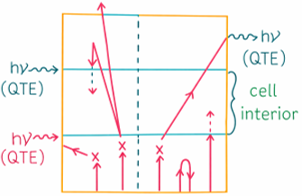
This manuscript develops a theoretical framework in which irradiated metal complexes interact with cellular membranes through a dual-boundary energetic structure that enables selective intracellular trapping. Building on prior work in electromagnetic flux guidance, zero-resistivity domains, and discontinuity surfaces, the membrane is modelled as two discrete dissipative boundaries enclosing a low-loss interior. When a complex with initial kinetic energy encounters the first boundary, an energy cost is imposed; a second equivalent cost appears at the exit interface. The resulting inequality system divides motion into three non-overlapping regimes: rejection E0 < W if , trapping if W < E0 < 2W , and full transmission if . In the trapping interval, the complex enters the interior but cannot exit because no real-valued propagation state remains after the second dissipation event. This produces directional asymmetry without invoking biochemical affinity entry and exit are not reversible operations, and confinement emerges from the disappearance of admissible solutions rather than from force, binding, or potential wells. The model therefore predicts a physically grounded mechanism by which pathological membranes with altered boundary cost could, in principle, exhibit different trapping behaviour than healthy cells. While no therapeutic or clinical claim is made, the analysis identifies measurable indicators boundary dissipation, interior continuity, and exit-state collapse that define how the hypothesis could be experimentally tested. The work concludes by framing this mechanism as a conditional, testable proposal in theoretical biophysics.
Downloads
References
Farmer, J. R. (2025). Electromagnetic selectivity in membrane transport of metal complexes: A theoretical framework based on thickness and dissipation. Hyperscience International Journal, 70–78. https://doi.org/10.55672/hij2025pp70-78
Musakhail, M. A., & Farmer, J. R. (2024a). On the aether dynamics, twin paradox, and ultimate relativity of solar flares. Hyperscience International Journal, 37–57. https://doi.org/10.55672/hij2024pp37-57
Musakhail, M. A., & Farmer, J. R. (2024b). Theory of everything. Hyperscience International Journal, 10–23. https://doi.org/10.55672/hij2024pp10-23
Musakhail, M. A., & Farmer, J. R. (2024c). Solar flares and the aether dynamic. Hyperscience International Journal, 58–71. https://doi.org/10.55672/hij2024pp58-71
Musakhail, M. A., & Farmer, J. R. (2025). Unifying Newton’s force and aether dynamics: A first-principles mathematical approach. Hyperscience International Journal, 1–10. https://doi.org/10.55672/hij2025pp1-10
Published
Issue
Section
License
Copyright (c) 2025 International Journal of Fundamental Physical Sciences

This work is licensed under a Creative Commons Attribution-NoDerivatives 4.0 International License.


 WorldCat
  Scilit
  ORCID
ORCID  Dimensions
  Mendeley
  Lincoln Library
  Cambridge iDiscover