On The Absolute Motion in the Inertial Systems
DOI:
https://doi.org/10.14331/ijfps.2013.330054Keywords:
Laser application, Classical Mechanics, Inertial Systems, Absolute MotionAbstract
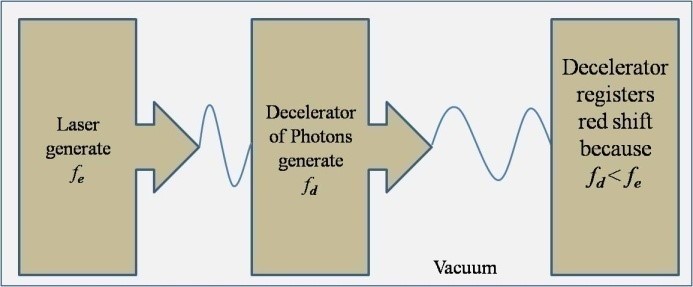
Through a mental experiment, the mechanics’ theory, about of the relative motion, is reexamined because the vacuum, frame of the movement, has a physical reality, which allows test the absolute motion, by the Doppler Effect induced by means of a decelerator of photons, affecting an electromagnetic wave in the direction of the motion of an inertial system. This Doppler does not exist in the nature because the source of the electromagnetic wave is in rest respect to system. But, in each cycle, due to which the wave propagates inside the decelerator, the speed of the system combined with the speed of the wave, respect to vacuum, provokes the induced Doppler. The result is that an observer, inside an inertial system, fully insulated from the outside, may determine whether his system is in rest or in motion and measure its speed, in absolute terms.
Downloads
References
Goldberg, K. A., & Naulleau, P. P. (2001). Dual-domain lateral shearing interferometer: WO Patent App. PCT/US2001/041,514.
Grant, E. (1981). Much Ado About Nothing: Theories of Space and Vacuum from the Middle Ages to the Scientific Revolution: Cambridge University Press.
Gross, A. G. (1993). Experiment as text: The limits of literary analysis. Rhetoric Review, 11(2), 290-300.
Minkowski, H. (1910). Die Grundgleichungen für die elektromagnetischen Vorgänge in bewegten Körpern. Mathematische Annalen, 68(4), 472-525.
Ranzan, C. (2008). The history of the aether theory: Published on Cellular Universe Website (www. CellularUniverse. org/AA3AetherHistory. htm) Section.
Schaffner, K. F. (1972). Nineteenth-century aether theories: Pergamon Press Oxford.D
Published
Issue
Section
License
Copyright (c) 2013 International Journal of Fundamental Physical Sciences

This work is licensed under a Creative Commons Attribution-NoDerivatives 4.0 International License.


 WorldCat
  Scilit
  ORCID
ORCID  Dimensions
  Mendeley
  Lincoln Library
  Cambridge iDiscover