Sunspots, Solar Rain, Solar Prominences, Solar Tsunamis, and Sunquakes as Strong Evidence for the Condensed-Matter Nature of the Sun
DOI:
https://doi.org/10.14331/ijfps.2026.330186Keywords:
Condensed-matter Sun, Sunspots, Solar prominences, Coronal rain, Solar tsunamisAbstract
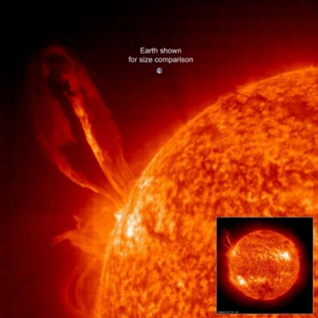
Almost all observations discussed in this work are interpreted as supporting the condensed-matter nature of the Sun. Regrettably, empirical solar data are generally interpreted with the Standard Solar Model (SSM) in mind. Consequently, interpretations of solar features and phenomena are expected to remain compatible with the SSM. For instance, sunspots, granules, and faculae are commonly treated as structures within a gaseous plasma, whereas the present work argues that they are real physical structures formed by condensed crystal lattices. In addition, the Sun's average density (approximately 1.41 g/cm³), which is comparable to that of Earth's oceans and slightly greater than that of water, is often interpreted within a mathematical model rather than considered as possible evidence for a condensed state. The present work argues that the overall density of the Sun is compatible with a condensed liquid state and that a purely gaseous body would not inherently possess the structural properties required for the observed solar dynamo. Moreover, the continuous solar spectrum is examined in relation to the physical state of solar matter. Dense, opaque matter can produce a continuous spectrum approximating blackbody radiation, whereas isolated low-density gases or plasmas characteristically produce discrete emission lines. Most importantly, this work argues that observed solar-dynamic phenomena such as sunspots, solar prominences, coronal rain, sunquakes, and solar tsunamis cannot be adequately explained without a liquid surface and a solid core.
Downloads
Author Biography
-
Dr. Jamal S. Shrair, Electronic Engineer and Independent Astrophysics Researcher, Austria
Electronic Engineer and Independent Astrophysics Researcher, Austria

References
Abetti, G. (1951). The sun. Faber and Faber.
Akasofu, S.-I. (2018). Three major paradigms in solar physics. Physics & Astronomy International Journal, 2(4), 336-339. https://doi.org/10.15406/paij.2018.02.00107
Akasofu, S.-I. (2022). Single sunspots, not pairs of spots, as the basic element of sunspots: A new synthesis of observed facts. American Journal of Planetary and Space Science, 1(1).
allen54.pdf. (n.d.). [Bibliographic details to be verified].
Antolin, P., Okamoto, T. J., De Pontieu, B., Uitenbroek, H., Van Doorsselaere, T., & Yokoyama, T. (2015). Resonant absorption of transverse oscillations and associated heating in a solar prominence. II. Numerical aspects. The Astrophysical Journal, 809, Article 72. https://doi.org/10.1088/0004-637X/809/1/72
Babcock, H. W. (1961). The topology of the Sun's magnetic field and the 22-year cycle. The Astrophysical Journal, 133, 572-587.
Bahcall, J. N., Pinsonneault, M. H., & Basu, S. (2001). Solar models: Current epoch and time dependences. The Astrophysical Journal, 555(2), 990.
Benavitz, L. F., Reep, J. W., Tarr, L. A., & To, A. S. H. (2025). Spatiotemporal low first ionization potential abundance: A catalyst for coronal condensation. The Astrophysical Journal, 992(1), Article 4. https://doi.org/10.3847/1538-4357/ae019d
Bray, R. J., & Loughhead, R. E. (1964). Sunspots. Chapman and Hall.
Brughmans, N., Jenkins, J. M., & Keppens, R. (2022). The influence of flux rope heating models on solar prominence formation. Astronomy & Astrophysics, 668, Article A47. https://doi.org/10.1051/0004-6361/202244071
Christensen-Dalsgaard, J. (2003). Solar structure and evolution. Reports on Progress in Physics, 66(7), 1079.
Cowling, T. G. (1953). Solar electrodynamics. In G. P. Kuiper (Ed.), The sun (pp. 532-591). University of Chicago Press.
de Jager, C. (1959). Structure and dynamics of the solar atmosphere. In S. Flügge (Ed.), Handbuch der Physik (Vol. 52, pp. 80-362). Springer.
del Pino Alemán, T., Trujillo Bueno, J., Štěpán, J., & Shchukina, N. (2018). A novel investigation of the small-scale magnetic activity of the quiet Sun via the Hanle effect in the Sr I 4607 Å line. The Astrophysical Journal, 863(2), Article 164. https://doi.org/10.3847/1538-4357/aaceab
Dutykh, D., & Dias, F. (2009). Energy of tsunami waves generated by bottom motion. Proceedings of the Royal Society A: Mathematical, Physical and Engineering Sciences, 465(2103), 725-744. https://doi.org/10.1098/rspa.2008.0332
Fraternale, F., Adhikari, L., Fichtner, H., Kim, T. K., Kleimann, J., Oughton, S., Pogorelov, N. V., Roytershteyn, V., Smith, C. W., Usmanov, A. V., Zank, G. P., & Zhao, L. (2022). Turbulence in the outer heliosphere. Space Science Reviews, 218, Article 50. https://doi.org/10.1007/s11214-022-00914-2
Gibson, S. E. (2018). Solar prominences: Theory and models. Living Reviews in Solar Physics, 15, Article 7. https://doi.org/10.1007/s41116-018-0016-2
Hale, G. E. (1908). On the probable existence of magnetic fields in sun-spots. The Astrophysical Journal, 28, 315-343.
Hanson, C. S., Bharati Das, S., Mani, P., Hanasoge, S., & Sreenivasan, K. R. (2024). Supergranular-scale solar convection not explained by mixing-length theory. Nature Astronomy, 8, 1088-1101. https://doi.org/10.1038/s41550-024-02304-w
Hanson, C. S., Hanasoge, S. M., & Sreenivasan, K. R. (2022). Discovery of high-frequency retrograde vorticity waves in the Sun. Nature Astronomy, 6, 708-714. https://doi.org/10.1038/s41550-022-01632-z
Hathaway, D. H. (2015). The solar cycle. Living Reviews in Solar Physics, 12, Article 4.
Helical Universe. (2017). The solar neutrino problem has not been solved. Journal of Advances in Physics, 13(4), 4821-4829.
Hnatič, M., Lučivjanský, T., Mižišin, L., Molotkov, Y., & Ovsiannikov, A. V. (2026). Magnetohydrodynamics in the turbulent dynamo regime: The stability problem. Theoretical and Mathematical Physics, 227(3), 996-1008. https://doi.org/10.1134/S0040577926060073
Homola, P., Marchenko, V., Napolitano, A., Damian, R., Guzik, R., Alvarez-Castillo, D., Stuglik, S., Ruimi, O., Skorenok, O., Zamora-Saa, J., Vaquero, J. M., Wibig, T., Knap, M., Dziadkowiec, K., Karpiel, M., Sushchov, O., Mietelski, J. W., Gorzkiewicz, K., Zabari, N., ... Tursunov, A. A. (2023). Observation of large scale precursor correlations between cosmic rays and earthquakes with a periodicity similar to the solar cycle. Journal of Atmospheric and Solar-Terrestrial Physics, 247, Article 106068. https://doi.org/10.1016/j.jastp.2023.106068
Hudson, H., MacKinnon, A., Szydlarski, M., & Carlsson, M. (2019). Cosmic-ray interactions in the solar atmosphere [Preprint]. arXiv. https://arxiv.org/abs/1910.01186
Ichimoto, K. (2010). The Evershed effect with SOT/Hinode. In S. S. Hasan & R. J. Rutten (Eds.), Magnetic coupling between the interior and atmosphere of the Sun (pp. 186-192). Springer. https://doi.org/10.1007/978-3-642-02859-5_14
Jing, J., Liu, C., Lee, J., Ji, H., Liu, N., Xu, Y., & Wang, H. (2018). Statistical analysis of torus and kink instabilities in solar eruptions. The Astrophysical Journal, 864(2), Article 138. https://doi.org/10.3847/1538-4357/aad6e4
Khomenko, E., Díaz, A., de Vicente, A., Collados, M., & Luna, M. (2014). Rayleigh-Taylor instability in prominences from numerical simulations including partial ionization effects. Astronomy & Astrophysics, 565, Article A45. https://doi.org/10.1051/0004-6361/201322918
Kiepenheuer, K. O. (1953). Solar activity. In G. P. Kuiper (Ed.), The sun. University of Chicago Press.
Koldobskiy, S. A., Kähkönen, R., Hofer, B., Krivova, N. A., Kovaltsov, G. A., & Usoskin, I. G. (2022). Time lag between cosmic-ray and solar variability: Sunspot numbers and open solar magnetic flux. Solar Physics, 297, Article 38. https://doi.org/10.1007/s11207-022-01970-1
Kuhn, J. R., Bush, R., Emilio, M., & Scholl, I. F. (2012). The precise solar shape and its variability. Science, 337(6102), 1638-1640. https://doi.org/10.1126/science.1223231
Li, J. (2018). A systematic study of Hale and anti-Hale sunspot physical parameters. The Astrophysical Journal, 867(2), Article 89. https://doi.org/10.3847/1538-4357/aae31a
Lindsey, C., Buitrago-Casas, J. C., Martínez Oliveros, J. C., Braun, D., Martínez, A. D., Quintero Ortega, V., Calvo-Mozo, B., & Donea, A. C. (2020). Submerged sources of transient acoustic emission from solar flares. The Astrophysical Journal Letters, 901(1), Article L9. https://doi.org/10.3847/2041-8213/abad2a
Lu, H., Li, X., & Lei, Q. (2021). Conjugated conductive polymer materials and its applications: A mini-review. Frontiers in Chemistry, 9, 732132. https://doi.org/10.3389/fchem.2021.732132
Mackay, D. H., Karpen, J. T., Ballester, J. L., Schmieder, B., & Aulanier, G. (2010). Physics of solar prominences: II - Magnetic structure and dynamics. Space Science Reviews, 151(4), 333-399. https://doi.org/10.1007/s11214-010-9628-0
Melgar, D., & Ruiz-Angulo, A. (2018). Long-lived tsunami edge waves and shelf resonance from the M8.2 Tehuantepec earthquake. Geophysical Research Letters, 45(22), 12414-12421. https://doi.org/10.1029/2018GL080823
Menzel, D. H. (1959). The sun. The Blakiston Company.
Mihalas, D. (1978). Stellar atmospheres. W. H. Freeman and Company.
Montesinos, B., & Thomas, J. H. (1998). The Evershed effect in sunspots: A theoretical explanation. Astrophysics and Space Science, 263, 323-326.
Müller, D. A. N., De Groof, A., Hansteen, V. H., & Peter, H. (2005). High-speed coronal rain. Astronomy & Astrophysics, 436(3), 1067-1074. https://doi.org/10.1051/0004-6361:20042141
Nagata, Y., Usui, K., & Bonn, M. (2015). Molecular mechanism of water evaporation. Physical Review Letters, 115(23), Article 236102. https://doi.org/10.1103/PhysRevLett.115.236102
National Aeronautics and Space Administration. (n.d.). Solar storms and flares. NASA Science. https://science.nasa.gov/sun/solar-storms-and-flares/
Nindos, A., Patsourakos, S., & Wiegelmann, T. (2012). On the role of the background overlying magnetic field in solar eruptions. The Astrophysical Journal Letters, 748(1), Article L6. https://doi.org/10.1088/2041-8205/748/1/L6
Nobel Prize Outreach. (n.d.). The four forces. NobelPrize.org. https://www.nobelprize.org/prizes/physics/1988/9553-the-four-forces/
Panesar, N. K., Innes, D. E., Schmit, D. J., & Tiwari, S. K. (2014). On the structure and evolution of a polar crown prominence/filament system. Solar Physics, 289(8). https://doi.org/10.1007/s11207-014-0504-z
Parenti, S. (2014). Solar prominences: Observations. Living Reviews in Solar Physics, 11, Article 1. https://doi.org/10.12942/lrsp-2014-1
Patsourakos, S., & Vourlidas, A. (2009). “Extreme ultraviolet waves” are waves: First quadrature observations of an extreme ultraviolet wave from STEREO. The Astrophysical Journal Letters, 700(2), L182-L186.
Rast, M. P., Bello González, N., Bellot Rubio, L., Cao, W., Cauzzi, G., DeLuca, E., et al. (2021). Critical science plan for the Daniel K. Inouye Solar Telescope (DKIST). Solar Physics, 296, Article 70. https://doi.org/10.1007/s11207-021-01789-2
Rimmele, T. R., Warner, M., Keil, S. L., Goode, P. R., Knölker, M., Kuhn, J. R., Rosner, R. R., McMullin, J. P., Casini, R., Lin, H., Wöger, F., & von der Lühe, O. (2020). The Daniel K. Inouye Solar Telescope - Observatory overview. Solar Physics, 295, Article 172. https://doi.org/10.1007/s11207-020-01736-7
Robitaille, P.-M. (2004). A high temperature liquid plasma model of the Sun [Preprint]. arXiv:astro-ph/0410075.
Robitaille, P.-M. (2011). Liquid metallic hydrogen: A building block for the liquid Sun. Progress in Physics, 3, 60-74.
Robitaille, P.-M. (2013a). Forty lines of evidence for condensed matter-The Sun on trial: Liquid metallic hydrogen as a solar building block. Progress in Physics, 4, 90-143.
Robitaille, P.-M. (2013b). The liquid metallic hydrogen model of the Sun and the solar atmosphere VIII: 'Futile' processes in the chromosphere. Progress in Physics, 3, L35-L40.
Saha equation foundations & limits. (n.d.). Stanford Solar Group / IUPAC Gold Book.
Schlichenmaier, R., et al. (2010). Formation of a sunspot in active region 11024. Astronomy & Astrophysics, 512, L1.
ScienceDirect Topics. (n.d.). Tsunami wave - an overview. Elsevier.
Shchukina, N., & Trujillo Bueno, J. (2003). The Hanle effect and the magnetic fields of the quiet Sun. In J. Trujillo Bueno & J. Sánchez Almeida (Eds.), Solar polarization 3 (ASP Conference Series, Vol. 307, pp. 336-343). Astronomical Society of the Pacific.
Soika, A. K. (2021). Revisiting the nature of dark sunspots: The Sun as a heat engine. Physics & Astronomy International Journal, 5(1), 6-9. https://doi.org/10.15406/paij.2021.05.00228
Solanki, S. K. (2003). Sunspots: An overview. The Astronomy and Astrophysics Review, 11(2-3), 153-286.
Su, Y., van Ballegooijen, A., McCauley, P. I., Ji, H., Reeves, K. K., & DeLuca, E. E. (2015). Magnetic structure and dynamics of the erupting solar polar crown prominence on 2012 March 12. The Astrophysical Journal, 807(2), Article 144. https://doi.org/10.1088/0004-637X/807/2/144
Sun, Z., Tian, H., Li, T., Liu, R., & Duan, Y. (2024). Fast downflows observed during a polar crown filament eruption. The Astrophysical Journal, 974(2), Article 205. https://doi.org/10.3847/1538-4357/ad738d
Swanson, D. G. (2003). Plasma waves (2nd ed.). Institute of Physics Publishing.
Trelles Arjona, J. C., Martínez González, M. J., & Ruiz Cobo, B. (2021). Mapping the hidden magnetic field of the quiet Sun. The Astrophysical Journal Letters, 915(1), L20. https://doi.org/10.3847/2041-8213/ac0af2
Trujillo Bueno, J., Asensio Ramos, A., & Shchukina, N. (2006). The Hanle effect in atomic and molecular lines: A new look at the Sun's hidden magnetism. In R. Casini & B. W. Lites (Eds.), Solar polarization 4 (ASP Conference Series, Vol. 358, pp. 269-292). Astronomical Society of the Pacific.
Trujillo Bueno, J., Shchukina, N., & Asensio Ramos, A. (2004). A substantial amount of hidden magnetic energy in the quiet Sun. Nature, 430(6997), 326-329. https://doi.org/10.1038/nature02669
UCAR Center for Science Education. (n.d.). The surface of the Sun. https://scied.ucar.edu/learning-zone/sun-space-weather/surface-of-the-sun
University of Hawaii Stellar Spectra Guidelines. (n.d.). Photospheric and chromospheric pressure estimates.
van Driel-Gesztelyi, L., & Green, L. M. (2015). Evolution of active regions. Living Reviews in Solar Physics, 12, Article 1. https://doi.org/10.1007/lrsp-2015-1
Vaquero, J. M. (2007). Historical sunspot observations: A review. Advances in Space Research, 40(7), 929-941. https://doi.org/10.1016/j.asr.2007.01.087
Vashalomidze, Z., Kukhianidze, V., Zaqarashvili, T. V., Oliver, R., Shergelashvili, B., Ramishvili, G., Poedts, S., & De Causmaecker, P. (2015). Formation and evolution of coronal rain observed by SDO/AIA on February 22, 2012. Astronomy & Astrophysics, 577, Article A136. https://doi.org/10.1051/0004-6361/201424101
Wang, L.-S. (2017). The second law: From Carnot to Thomson-Clausius, to the theory of exergy, and to the entropy-growth potential principle. Entropy, 19(2), 57. https://doi.org/10.3390/e19020057
Warmuth, A., Vršnak, B., Magdalenić, J., Hanslmeier, A., & Otruba, W. (2004). A multiwavelength study of solar flare waves. II. Perturbation characteristics and physical interpretation. Astronomy & Astrophysics, 418(3), 1117-1129. https://doi.org/10.1051/0004-6361:20034333
Wiegelmann, T., Thalmann, J. K., & Solanki, S. K. (2014). The magnetic field in the solar atmosphere. Astronomy and Astrophysics Review, 22, Article 78. https://doi.org/10.1007/s00159-014-0078-7
Wikipedia contributors. (n.d.-a). Maxwell stress tensor. In Wikipedia.
Wikipedia contributors. (n.d.-b). Landau damping. In Wikipedia.
Wyslouzil, B. E., & Wölk, J. (2016). Overview: Homogeneous nucleation from the vapor phase. The experimental science. The Journal of Chemical Physics, 145(21), Article 211702. https://doi.org/10.1063/1.4962283
Xia, C., & Keppens, R. (2016). Formation and plasma circulation of solar prominences. The Astrophysical Journal, 823(1), Article 22. https://doi.org/10.3847/0004-637X/823/1/22
Zessner, L.-M., Cameron, R. H., Solanki, S. K., & Przybylski, D. (2026). Self-consistent numerical simulations for the formation and dynamics of solar prominences. Nature Astronomy, 10, 952-963. https://doi.org/10.1038/s41550-026-02840-7
Zhong, Z., Chen, Y., Ni, Y. W., Chen, P. F., Zheng, R., Kong, X., & Li, C. (2025). The magnetic origin of the mystery of rare Hα Moreton waves. The Astrophysical Journal, 980(1), Article 42. https://doi.org/10.3847/1538-4357/ada387
Zhou, Y. (2025). The formation of solar prominences: Plasma origin and mechanisms. Review of Modern Plasma Physics, 9, Article 32
Published
Issue
Section
License
Copyright (c) 2026 The Authors

This work is licensed under a Creative Commons Attribution-NonCommercial 4.0 International License.


 WorldCat
  Scilit
  ORCID
ORCID  Dimensions
  Mendeley
  Lincoln Library
  Cambridge iDiscover